Industrial Automation Systems: Insights Into Robotics, Control Systems, and Sensors
Industrial automation systems combine robotics, control systems, sensors, software, and industrial networks to monitor and manage physical processes.
They are used across manufacturing, energy, logistics, food processing, pharmaceuticals, automotive production, and other industrial environments.
Modern industrial automation systems are increasingly connected and data-driven. Programmable logic controllers (PLCs), supervisory control and data acquisition (SCADA), distributed control systems (DCS), industrial robots, and smart sensors can work together to improve process consistency, safety, monitoring, and operational decision-making.
Context
Industrial automation refers to the use of technology to perform or control industrial processes with limited direct human intervention. Early automation relied heavily on mechanical systems, relays, timers, and dedicated control equipment. Modern systems combine digital controllers, computer networks, software, sensors, robotics, and data analysis.
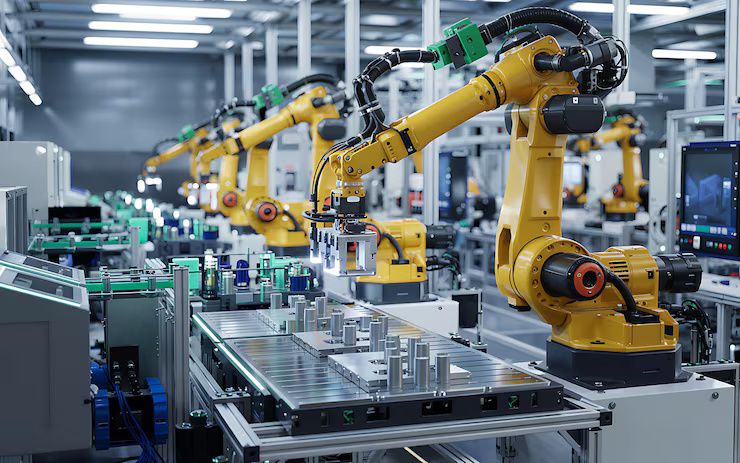
A typical industrial automation system contains several connected layers. Sensors measure physical conditions such as temperature, pressure, position, flow, vibration, or speed. Controllers interpret this information and determine what actions should occur. Actuators then control equipment such as motors, valves, pumps, conveyors, and robotic mechanisms.
| Component | Main function | Common examples |
|---|---|---|
| Sensors | Detect physical conditions | Temperature, pressure, proximity |
| PLCs | Execute control logic | Machine and process control |
| SCADA | Monitor processes | Industrial dashboards |
| DCS | Coordinate continuous processes | Chemical and energy plants |
| Robots | Perform physical tasks | Assembly, welding, handling |
| Actuators | Produce physical movement | Motors, valves, cylinders |
| Industrial networks | Connect equipment | Ethernet-based industrial networks |
Robotics is an important part of industrial automation. Industrial robots can perform repetitive or precisely controlled activities such as material handling, assembly, welding, inspection, and palletizing. Collaborative robotic systems can also be designed to work in environments where people and machines operate near one another, subject to appropriate risk assessment and safeguards.
Control systems provide the decision-making structure behind automated processes. A PLC may repeatedly read sensor signals, compare them with programmed conditions, and activate outputs. More complex environments may use SCADA or DCS architectures to coordinate multiple machines and processes.
Importance
Industrial automation systems matter because many industrial processes require consistent control, accurate measurement, rapid responses, and continuous monitoring. Automation can help reduce variation in repetitive processes and provide operators with clearer information about equipment conditions.
The technology affects several groups, including:
- Production and process engineers
- Automation and control engineers
- Machine operators and technicians
- Safety professionals
- Maintenance teams
- Industrial cybersecurity teams
- Manufacturers and system integrators
- Organizations responsible for regulatory compliance
Sensors are particularly important because automated decisions depend on the quality and availability of measurement data. A faulty temperature sensor, pressure transmitter, encoder, or proximity sensor can cause incorrect control actions. For this reason, sensor selection, calibration, diagnostics, redundancy, and maintenance are important parts of automation planning.
Cybersecurity is also increasingly important. Industrial control systems are becoming more connected to enterprise networks and other digital systems. NIST guidance notes that industrial control systems have distinct performance, reliability, and safety requirements that must be considered when applying cybersecurity measures.
A well-designed system therefore considers both physical safety and digital security. Network segmentation, access control, authentication, monitoring, secure configuration, change management, and incident response can all contribute to stronger industrial control system protection.
Recent Updates
Industrial automation has been developing toward greater connectivity, intelligent sensing, robotics, and data-based monitoring. Edge computing allows some data processing to occur close to machines instead of sending every measurement to a distant computing environment.
Artificial intelligence and machine learning are also being explored for industrial applications such as anomaly detection, predictive maintenance, quality inspection, process optimization, and robotics. However, these technologies require appropriate validation because incorrect predictions can affect physical equipment and safety.
One important recent development is the publication of ISO 10218-1:2025, which establishes safety requirements for industrial robots. ISO 10218-2:2025 addresses industrial robot applications and robot cells, including integration, commissioning, operation, maintenance, and decommissioning.
Cybersecurity standards are developing alongside automation technology. IEC PAS 62443-2-2:2025 provides guidance for developing and maintaining a security protection scheme for industrial automation and control systems. It focuses on technical, physical, and process measures for managing cybersecurity risks.
NIST has also continued work on manufacturing cybersecurity. Its 2026 draft guidance on responding to and recovering from cyberattacks addresses incident response and operational resilience for industrial control environments.
Another trend is greater integration between operational technology and information technology. This can provide better visibility and analytics, but it also increases the importance of secure architecture, identity management, network monitoring, and controlled access.
Laws or Policies
Industrial automation requirements depend on the country, industry, machine type, and intended operating environment. Organizations should identify the laws, technical standards, workplace safety requirements, electrical rules, and cybersecurity obligations that apply to their particular system.
International standards frequently provide an important technical reference. ISO 10218:2025 addresses industrial robot safety, while the IEC 62443 family addresses cybersecurity for industrial automation and control systems. These standards should be considered alongside applicable national laws rather than treated as universal legal requirements.
In the European Union, Regulation (EU) 2023/1230 on machinery is scheduled to apply from 20 January 2027. The regulation covers machinery, related products, safety components, and partly completed machinery, and includes provisions relevant to digital technologies and cyber-safety.
The European Union AI Act is another relevant development where artificial intelligence is incorporated into regulated products or industrial processes. The Act entered into force on 1 August 2024, with its general applicability beginning on 2 August 2026 and specific provisions following different transition periods.
Organizations operating industrial automation equipment should therefore review applicable requirements before deployment, modification, or integration. Risk assessment, technical documentation, safety validation, cybersecurity controls, and conformity procedures may be relevant depending on the application.
Tools and Resources
Several established resources can help readers understand industrial automation systems and related technical requirements.
Useful resources include:
- NIST publications on industrial control system and operational technology security
- IEC standards relating to industrial automation and control systems
- ISO standards covering industrial robot safety
- EUR-Lex for European Union legislation and consolidated legal texts
- National workplace safety authorities and machinery regulators
- PLC and SCADA documentation from equipment manufacturers
- Engineering calculators for electrical, mechanical, and process measurements
- Industrial network documentation and cybersecurity assessment frameworks
NIST's industrial control system resources include guidance covering SCADA, PLCs, DCS architectures, networks, sensors, risk assessment, and security controls.
When evaluating an automation architecture, a simple checklist can help identify major considerations:
- What physical process needs to be monitored or controlled?
- Which measurements require sensors?
- Which controller architecture is appropriate?
- What safety functions are required?
- How will machines communicate?
- What cybersecurity controls are necessary?
- Which laws and standards apply?
- How will testing, documentation, maintenance, and updates be managed?
FAQs
What are industrial automation systems?
Industrial automation systems are combinations of controllers, sensors, actuators, software, networks, and machines used to monitor and control industrial processes.
What role do sensors play in industrial automation?
Sensors measure physical conditions such as temperature, pressure, position, speed, flow, and vibration. Their measurements provide information that controllers can use to make automated decisions.
How are robotics and control systems connected?
Robots generally operate through controllers that coordinate motion, inputs, outputs, safety functions, and communication with other equipment. They can form part of a larger automated production cell.
Why is cybersecurity important for automation systems?
Connected control systems can face cybersecurity risks that may affect equipment, data, process continuity, and physical safety. Security measures should account for the special reliability and safety requirements of operational technology.
What standards are relevant to industrial robots?
ISO 10218-1:2025 addresses safety requirements for industrial robots, while ISO 10218-2:2025 focuses on industrial robot applications and robot cells.
Conclusion
Industrial automation systems bring together robotics, control systems, sensors, networks, software, and physical equipment to manage industrial processes. Their development is increasingly shaped by connectivity, intelligent monitoring, cybersecurity, and updated machinery and robot safety requirements.
Understanding the relationship between sensors, controllers, robots, and industrial networks provides a useful foundation for evaluating automated environments. Organizations should also consider risk assessment, applicable regulations, cybersecurity, safety standards, documentation, and ongoing system maintenance when planning or operating automation systems.
Automation technology will continue to evolve as industrial facilities adopt more connected equipment and data-driven control methods. Responsible implementation requires balancing technological capabilities with safety, reliability, cybersecurity, and regulatory considerations.

Related Post...
Sales and Service Management Software Basics for Business Process Management
Updated: October 21, 2026
Read More

Starlink Internet Plans Insights: Explore Speed, Latency, Availability, and Network Performance
Updated: October 13, 2026
Read More