Chemical Industry Discover Guide: Explore Industrial Chemistry, Process Systems, and Material Science
The chemical industry plays an important role in modern manufacturing, agriculture, healthcare, construction, energy, and consumer products.
It uses scientific principles and industrial technologies to transform raw materials into chemicals, compounds, and specialized materials for a wide range of applications.
This Chemical Industry Discover Guide explains industrial chemistry, chemical processing systems, material science, recent technological developments, and relevant regulations. It provides a general introduction for students, researchers, manufacturers, and readers interested in understanding how chemical production works and how the industry manages safety, quality, and environmental responsibilities.
Context – Understanding the Chemical Industry
The chemical industry includes organizations and facilities that manufacture, process, formulate, and refine chemical substances. Its activities range from producing basic industrial chemicals to developing specialized materials used in electronics, medicines, agriculture, textiles, and construction.
Industrial chemistry applies chemical reactions and scientific knowledge on a large scale. Processes may involve mixing, heating, cooling, separation, purification, crystallization, and controlled reactions. Engineers use process systems to manage these operations while maintaining appropriate quality and safety conditions.
The industry includes several major segments.
| Chemical industry segment | Main activities | Common applications |
|---|---|---|
| Basic chemicals | Producing large-volume chemical compounds | Manufacturing, water treatment, and industrial processing |
| Petrochemicals | Processing petroleum and natural gas derivatives | Plastics, synthetic fibers, and chemical intermediates |
| Specialty chemicals | Developing chemicals for specific functions | Coatings, adhesives, electronics, and water treatment |
| Agricultural chemicals | Producing fertilizers and crop-protection compounds | Crop nutrition and agricultural management |
| Pharmaceutical chemicals | Producing active ingredients and chemical intermediates | Medicines and pharmaceutical manufacturing |
| Polymers and materials | Developing plastics, resins, and related materials | Packaging, automotive components, and construction |
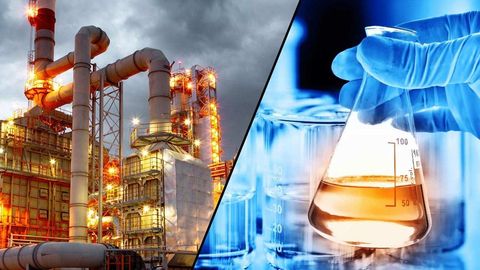
Chemical plants use equipment such as reactors, distillation columns, heat exchangers, pumps, storage tanks, and filtration systems. Instrumentation measures variables such as temperature, pressure, flow, and chemical composition.
Process control systems use this information to maintain operating conditions within defined limits. Depending on the process, computerized monitoring and automated control can help improve consistency and identify abnormal conditions.
Material science complements industrial chemistry by examining how a material's composition, structure, and processing affect its properties. This knowledge helps explain why different polymers, metals, ceramics, and composites behave differently under heat, pressure, moisture, and mechanical stress.
Importance – Why the Chemical Industry Matters
The chemical industry supports numerous economic activities because chemicals and engineered materials are used throughout modern supply chains. Agricultural production depends on fertilizers and other chemical inputs, while construction uses materials such as coatings, sealants, polymers, and additives.
Healthcare also relies on chemical manufacturing for pharmaceutical ingredients, laboratory reagents, disinfectants, and materials used in medical equipment. Electronics manufacturing requires high-purity chemicals for processes such as semiconductor fabrication.
The industry also influences energy use, waste generation, water consumption, and greenhouse gas emissions. These effects make efficient process design and environmental management important considerations.
Several areas demonstrate the industry's broader importance:
Industrial chemistry supports the development and production of materials with specific properties.
Process engineering helps manage reactions, energy transfer, separation, and product consistency.
Material science contributes to lighter components, corrosion resistance, insulation, and durability.
Quality-control systems help identify contamination and deviations from manufacturing specifications.
Environmental engineering supports wastewater treatment, emissions control, and waste management.
Chemical production can also involve hazards, including toxic exposure, fire, explosion, corrosive substances, and uncontrolled reactions. Appropriate engineering safeguards, operating procedures, training, and emergency planning are therefore essential.
The level of risk depends on the substance, its quantity, operating conditions, equipment design, and the surrounding environment.
Recent Updates – Technology and Industry Developments
The chemical industry continues to change through advances in process automation, digital monitoring, materials research, and environmental management. These developments aim to improve process understanding, resource efficiency, product consistency, and operational safety.
Digital technologies are increasingly used to collect and analyze information from industrial equipment. Sensors can monitor temperature, pressure, flow, vibration, and other operating variables. Data-analysis systems can help engineers identify unusual patterns and investigate equipment performance.
Artificial intelligence and machine learning are also being studied for process optimization, predictive maintenance, laboratory research, and materials discovery. Their usefulness depends on data quality, appropriate validation, and the consequences of incorrect predictions.
Another important area is the development of lower-emission chemical production. Research includes electrified heating, improved catalysts, alternative feedstocks, carbon capture, and the use of renewable electricity in suitable processes.
Circular chemistry is also receiving attention. It focuses on designing materials and processes that reduce waste, improve recovery, and support the reuse or recycling of chemical products where technically feasible.
Important developments include:
Research into catalysts that improve reaction efficiency or selectivity.
Greater use of digital twins to model and monitor industrial processes.
Development of polymers designed for improved recyclability.
Increased attention to energy and water efficiency.
Research into alternative feedstocks and lower-carbon manufacturing methods.
These approaches have different levels of commercial maturity. Results depend on the chemical process, available infrastructure, material properties, energy sources, and environmental conditions.
Laws or Policies – Chemical Safety and Environmental Rules
Chemical manufacturing is subject to regulations intended to protect workers, communities, consumers, and the environment. Requirements vary according to the country, chemical classification, production activity, and potential hazards.
In India, the Environment (Protection) Act, 1986 provides a central framework for environmental protection. Related rules and notifications address different aspects of industrial pollution, hazardous substances, environmental approvals, and waste management.
The Manufacture, Storage and Import of Hazardous Chemical Rules, 1989 establish requirements for specified hazardous chemicals and activities. Depending on the applicable provisions and quantities involved, facilities may need to assess major accident hazards, prepare emergency plans, and maintain safety information.
The Factories Act, 1948 historically established workplace health and safety requirements for factories, alongside related rules. India has also enacted the Occupational Safety, Health and Working Conditions Code, 2020. The application of these provisions depends on the current commencement and implementation framework, relevant rules, and other applicable requirements.
Internationally, the Globally Harmonized System of Classification and Labelling of Chemicals (GHS) provides a framework for classifying chemical hazards and communicating them through labels and safety data sheets. Its implementation varies between jurisdictions.
Chemical facilities commonly need to consider:
Chemical classification, labeling, and safety data sheets.
Worker training and exposure prevention.
Storage compatibility and emergency procedures.
Air emissions, wastewater, and hazardous waste requirements.
Process safety assessments and incident reporting where applicable.
Compliance requires more than maintaining documentation. Facilities must determine which legal requirements apply to their operations and implement appropriate technical and organizational controls.
Tools and Resources – Learning Industrial Chemistry
A range of educational and technical resources can help readers learn about chemical processes, materials, equipment, and safety requirements.
Useful resource categories include:
Chemistry textbooks and university learning materials for chemical reactions, thermodynamics, and reaction kinetics.
Process engineering references for reactor design, distillation, heat transfer, and fluid flow.
Material science databases for understanding polymers, metals, ceramics, and composites.
Safety data sheets for information about chemical hazards, handling, storage, and emergency measures.
Process simulation software for studying flowsheets, mass balances, energy balances, and equipment behavior.
Environmental monitoring guidance for understanding emissions, wastewater treatment, and waste management.
Common engineering calculations include mass balance, energy balance, heat-transfer calculations, reaction conversion, and separation efficiency. These calculations help engineers estimate process requirements and investigate performance.
For example, a mass balance compares material entering a process with material leaving it and any accumulation within the system. An energy balance accounts for energy entering, leaving, or accumulating during an operation.
Simulation tools can help evaluate possible operating conditions before changes are made in a plant. However, simulation results depend on the assumptions, physical-property data, reaction models, and equipment information used.
Practical industrial decisions should also consider experimental validation, equipment limitations, process hazards, and applicable engineering standards.
FAQs – Chemical Industry and Industrial Chemistry
What does the chemical industry produce?
The chemical industry produces basic chemicals, petrochemicals, polymers, fertilizers, pharmaceutical ingredients, specialty chemicals, and many other substances used in manufacturing, agriculture, healthcare, and construction.
What is industrial chemistry?
Industrial chemistry applies chemical science to large-scale production. It includes reaction design, separation, purification, quality control, process monitoring, and the development of efficient manufacturing methods.
What is the role of material science in chemical manufacturing?
Material science examines how composition, structure, and processing affect material properties. It helps researchers understand durability, corrosion resistance, strength, flexibility, thermal behavior, and other characteristics.
How do chemical plants maintain process safety?
Chemical plants use risk assessments, suitable equipment design, process controls, alarms, protective systems, worker training, maintenance, and emergency procedures. The safeguards required depend on the hazards and operating conditions.
How is technology changing the chemical industry?
Automation, digital monitoring, process simulation, artificial intelligence, and materials research are changing how chemical processes are studied and managed. Their results depend on appropriate data, validation, and implementation.
Conclusion – Understanding the Chemical Industry
The chemical industry connects scientific research with large-scale manufacturing through industrial chemistry, process systems, and material science. Its activities support many sectors while requiring careful attention to product quality, worker safety, environmental impacts, and regulatory responsibilities.
Understanding chemical reactions, industrial equipment, process control, and material properties provides a foundation for learning how chemical production operates. Advances in automation, alternative feedstocks, and resource efficiency continue to influence research and manufacturing practices.
A balanced understanding of the industry includes both its practical contributions and its potential hazards. Reliable scientific information, suitable engineering controls, and compliance with applicable regulations remain essential to responsible chemical production.

Related Post...
Chemical Manufacturing Resources: A Complete Guide to Equipment, Processes, and Industry Standards
Updated: October 12, 2026
Read More
Material Shaping Guide: Understanding Common Techniques, Tools, and Processes
Updated: September 07, 2026
Read More
Automotive Parts Information Guide: Understanding Vehicle Technology
Updated: July 22, 2026
Read More